


My band has multiple people who have vocals and at least one, maybe two instruments. We played three gigs with a stack of practice amps and Scarletts and switcher pedals. This makes knowledgeable people pause a moment and say “huh, you did what now?” So here’s how it works… two instruments go into a Boss A/B pedal, which goes into a Focusrite Scarlett 2i2 or Solo. Vocal mike also goes into the Scarlett, and a Y-cable goes out of it into the amp’s input. You need 5v USB-C to power the Scarlett. This is the kind of setup you get by incrementally solving one problem at a time of course, but it suited to prove that we could entertain an audience together. Unfortunately, balance is a tough thing to control when you’ve got as many as twenty volume and gain control knobs on one stage. Also feedback is a constant risk, and it’s tough to hear each other. This stack is like Unix pipeline philosophy implemented in sound gear.
So, I decided to invest into a board and loudspeaker system… it’d be nice to have monitors and easier feedback control. We already have a couple of Bose S1 Pros (with dead batteries, boo). I figure we can use those for monitors, so I bought two Yamaha DSR112’s and tripods to put them on, and a Behringer XR18. The Behringer was a tough decision. The general consensus of friends and weirdos on the Internet is that an old school mixer board is a waste of money today, and I certainly don’t want to have that much stage space used up. I’d rather not require a computer or tablet to control the mixer, but whoah, the equivalent Allen & Heath with a touchscreen is over twice as much money. So, Behringer XR18, which has been quite a learning curve.
Obviously step one is networking and app support. I saw a fair amount of confusion online. I am using an M1 MacBook Air. This works with wired Ethernet (Anker dock to an old Apple USB-A Ethernet dongle to RJ-45 cable) using fixed IP addresses. It works over my home wifi network (using WPA-2 and 2.4GHz). And it works using the Behringer’s built-in AP. Technically the iPad app can run on this macbook, but touch controls don’t work right, so I’m using the X-Air Edit Mac app. Upgraded firmware, got sound to come out of main and monitor ports, it’s a start. One gotcha to watch out for, it’s difficult to tell if the app has disconnected from the mixer, which can be frustrating.
To get further, I had to find the PDF manual and read the whole thing, including sections that don’t seem relevant like iPad and Android app instructions, in order to get the hints of things like “there is a special bus that channels get connected to when you hit the solo button on them”. And of course, like any technical writing, it’s got a few gems like “The Meters, Shows, Effects, Routing and Setup buttons allow direct access to these menus.” Sweetwater has some handy articles explaining this stuff, such as What Are PFL, AFL, and SIP?. I haven’t really needed to tackle a lot of the complexity that you can apply to each channel, but it’s good to know it’s there.
The speakers are bigger than I expected, which is funny since I did actually look at the dimensions, but reality be like that. The sound is good to my untutored ear. My last band used a massive pair of JBLs that weighed twice as much (probably all the cat hair). Those only had one working setup, due to old cables permanently jammed into ports, so I appreciate the upgrade. I also bought covers so I can keep them clean.
The stands: I really like my Ultimate Support folding guitar stand and microphone stand, so I figured these would be good. They are okay, but I’m not entirely thrilled with how they lock. The spinning motion is fine, but I don’t like that the locking is only against downward motion. Upward is still allowed, which means you have to be careful where you grip to move them around before putting the speakers on. The tripod allows a lot of freedom of motion before you clamp it, and I do like that it’s all light-weight aluminum. Also, don’t forget to raise the silver insert before trying to mount a speaker.
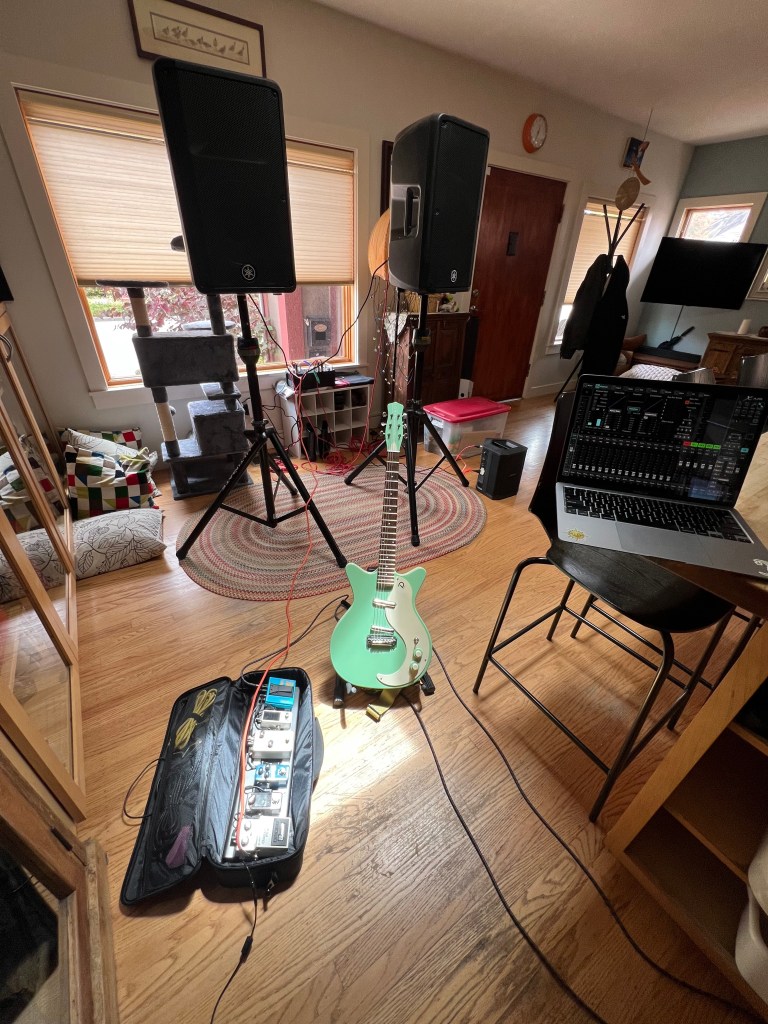
Practice setup in my living room with one instrument (I love that Dano, a lot more fun to play than the Telecaster it replaced).
 Monkeynoodle.Org